The Funeral of the Man You Could Have Been
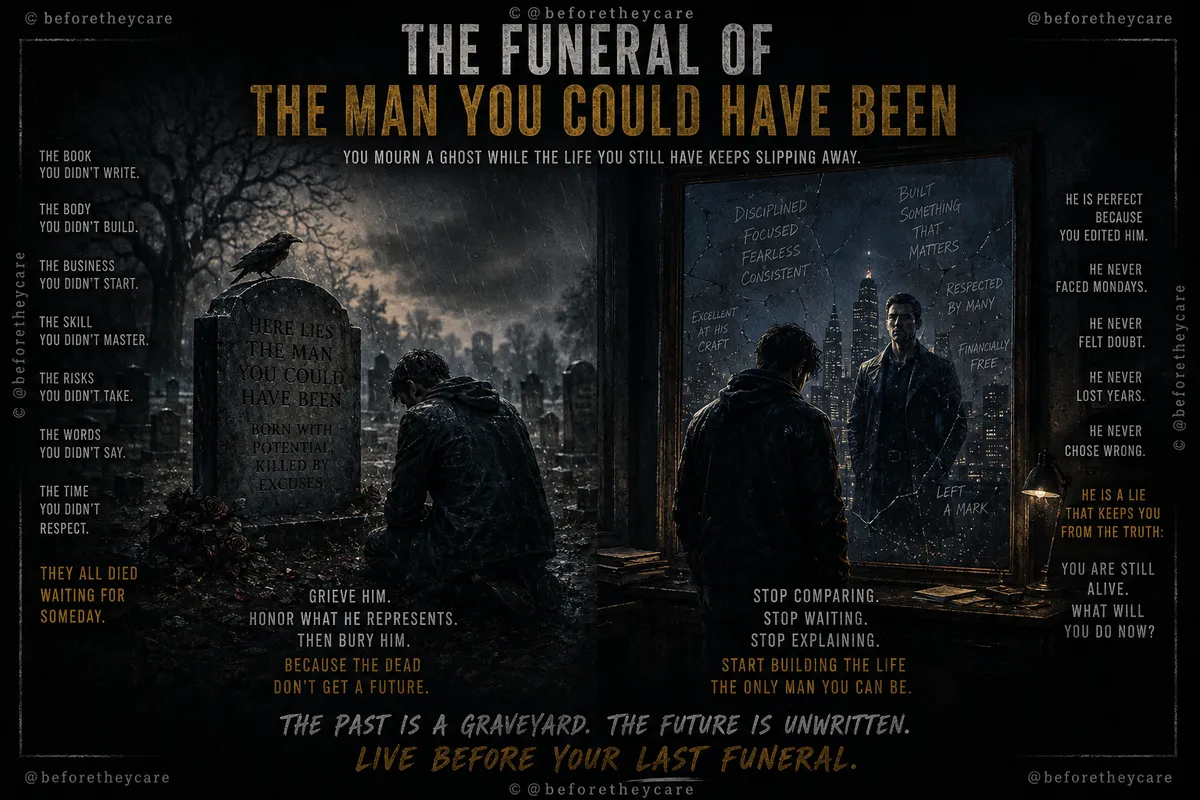
There will be no coffin.
No priest.
No flowers dying in expensive vases.
No black clothes. No trembling hands lowering polished wood into the earth. No crowd standing around pretending they knew him better than they did.
Because the dead man never existed.
And yet you have mourned him for years.
The man you could have been.
You know him intimately.
You know the university he would have attended if he had understood the value of time. You know the work he would have produced if he had not become distracted. You know the body he would have built, the books he would have finished, the risks he would have taken, the money he would have made, the rooms his name would have opened.
You know how he would speak.
How he would enter a room without shrinking.
How he would look in the mirror without immediately remembering everything he abandoned.
He has your face.
But none of your mistakes.
He inherited your intelligence and escaped your fear.
He received your ambition without your inconsistency.
He was given your gifts and somehow knew exactly what to do with them.
Of course he became extraordinary.
He was designed by hindsight.
And every day, you stand beside his imaginary grave and apologize for being alive instead of him.
Enough.
It is time to bury the bastard.
He Did Not Die All at Once
There was no single moment when the life you imagined collapsed.
That would have been easier.
A dramatic failure can be named.
A rejection letter.
A failed examination.
A business destroyed.
A door slammed shut.
You can point to the date and say:
There. That is where it ended.
But most unlived lives do not die violently.
They starve.
One postponed morning at a time.
One unfinished book.
One opportunity you were “not ready for.”
One more month spent planning instead of beginning.
One more year telling yourself that you worked best under pressure.
One more obsession abandoned when it stopped flattering your intelligence.
Nothing seemed fatal while it was happening.
That was the trick.
You skipped one day and remained talented.
You wasted one year and remained young.
You quit one difficult thing and found another thing that made you feel promising again.
The future still looked enormous.
There was always enough time to become serious later.
Then later arrived with grey in its hair and receipts in its hands.
The life you postponed had expired.
Not all of it.
But parts.
Real parts.
Doors do close.
Bodies change.
Responsibilities multiply.
Certain races cannot be entered forever.
Certain compounding years cannot be recovered by intensity.
You can work harder now.
You cannot work yesterday.
That is the first truth spoken at this funeral:
Some of what you lost is actually gone.
Do not insult yourself with cheap optimism.
Do not say everything happened for a reason.
Sometimes you wasted time.
Sometimes you were afraid.
Sometimes you were arrogant enough to believe that natural ability would wait for you untouched.
Sometimes you fucked up.
That is the entire explanation.
You fucked up.
And the clock did not stop out of sympathy.
Talent Was the Perfect Anaesthetic
The most dangerous thing that can happen to a young person is discovering that they are talented before discovering that talent is not enough.
Talent gave you evidence without demanding character.
You understood quickly.
You noticed patterns.
You produced flashes that made people turn their heads.
You did things with little preparation that others could not do after serious effort.
It felt like prophecy.
You thought ease meant destiny.
You believed that because you could begin faster, you would eventually finish farther.
But talent has a dark side.
It allows a person to remain drunk on possibility while producing almost nothing.
You could always tell yourself:
I have not really tried yet.
What a beautiful escape.
If you failed without trying, the failure proved nothing.
If you quit before the final test, your ability remained unmeasured.
If you abandoned the field after a few months, you could preserve the belief that years of commitment would have made you exceptional.
You never had to meet your limits.
You only had to keep leaving before they introduced themselves.
That is how talent became your anaesthetic.
It numbed the pain of an empty record.
You had no body of work, but you had potential.
No mastery, but potential.
No proof, but potential.
No finished thing you could place on a table and say, This exists because I remained.
Still, you had potential.
Potential became the medal you awarded yourself for a race you refused to finish.
Years passed.
The word changed.
At sixteen, potential sounded like promise.
At twenty-five, it sounded like delay.
At thirty-five, it began to sound like an accusation.
Because potential is not an achievement.
It is unfinished business.
And unfinished business eventually starts haunting the house.
You Did Not Fail Enough
You tell yourself you failed.
Perhaps you did.
But often, you did something more comfortable.
You escaped before failure could become conclusive.
You left when the work became repetitive.
You changed direction when progress slowed.
You called it curiosity.
You called it adaptability.
You called it searching for the right path.
Sometimes it was.
Other times, you were simply terrified of discovering that you were not immediately exceptional.
The beginning of anything made you feel alive.
New books.
New language.
New tools.
New identity.
For a few weeks, perhaps a few months, everything moved quickly. Your mind woke up. Ideas connected. You could almost see the future assembling itself.
Then the work became serious.
The field stopped complimenting you.
The problems took days instead of minutes.
People younger than you were already better.
People you considered less intelligent possessed something you did not:
Years.
Years of repetition.
Years of being wrong.
Years of continuing after the subject stopped making them feel special.
You reached the wall.
And instead of understanding that the wall was the entrance, you treated it as the exit.
You wanted mastery without the period in which mastery makes you look mediocre.
You wanted depth without humiliation.
You wanted the identity without enduring the apprenticeship.
So you left.
Again.
Each departure preserved the fantasy.
You could still say:
I might have become great at that.
Maybe.
But “might have” is the favourite currency of cowards and ghosts.
It purchases nothing in the world of the living.
The Cemetery of Almost
Look behind you.
There they are.
The graves.
The language you almost learned.
The company you almost built.
The paper you almost wrote.
The subject you almost mastered.
The body you almost transformed.
The examination you almost prepared for seriously.
The relationship you almost repaired.
The promise you almost kept.
The person you almost became.
Almost is seductive because it sounds close.
It is not close.
An unfinished bridge is not almost a bridge when the river is still beneath your feet.
A book trapped inside your head is not almost a book.
A theorem you never proved is not almost true.
A life you never built is not almost lived.
The cemetery is crowded because you kept mistaking intention for movement.
You thought wanting deeply counted.
You thought thinking constantly counted.
You thought collecting resources counted.
You thought explaining your plan counted.
But reality is viciously literal.
It counts what exists.
The page written.
The skill built.
The weight lifted.
The call made.
The application submitted.
The years endured.
The promise kept after the emotion that created it disappeared.
Your intentions do not have graves because they were never alive.
Only actions breathe.
You Keep Visiting Him
You visit the dead man whenever somebody else succeeds.
A former classmate gets promoted.
A younger researcher publishes.
Someone with less natural ability develops frightening competence.
A man your age stands where you once imagined standing.
You smile.
Congratulate them.
Then something cold moves beneath your ribs.
It is not always jealousy.
Sometimes it is recognition.
You are not merely seeing their achievement.
You are seeing evidence from the alternate life.
The one in which you started when they started.
Stayed when they stayed.
Accumulated while they accumulated.
Their success becomes a window into the man you buried.
That is why it hurts disproportionately.
They are not only ahead of you.
They are standing where your ghost lives.
So you visit him.
You replay the years.
You imagine different teachers.
Different choices.
A more disciplined youth.
A braver decision.
A morning when you somehow understood that time was not an endless resource but a blade moving silently toward the throat of every possibility.
You reconstruct your life with the precision of a historian and the mercy of an executioner.
You know exactly what your younger self should have done.
Of course you do.
You possess information he had to suffer in order for you to learn.
Then you use that information to condemn him.
And because he cannot hear you, you punish the only person available.
The present one.
The Imaginary Man Has Never Survived a Tuesday
You have made the ghost too powerful.
You imagine him disciplined every day.
Focused every morning.
Certain about his purpose.
Unafraid of sacrifice.
But he has never lived through an ordinary Tuesday.
He has never woken after poor sleep with a sick child in the next room.
Never received bad news.
Never doubted his field.
Never made the wrong investment.
Never trusted the wrong person.
Never lost years to confusion.
Never sat before work that had become dry, repetitive and unromantic.
Never faced the possibility that the goal he pursued was not the goal he truly wanted.
He has never had to live forward.
You write him backward.
That is his advantage.
Every decision he makes is correct because you already know which decisions damaged you.
Every opportunity is obvious because you know which opportunities mattered.
Every road is clean because you removed the mud.
He is not wiser than you.
He is edited.
Stop comparing a human being to an edited life.
Real people hesitate.
Real people choose badly.
Real people discover themselves late.
Real people carry responsibilities that ambition alone cannot erase.
Real people lose years.
Real people wake up one day surrounded by consequences and still have to decide what to do before breakfast.
The ghost has never done anything difficult.
He has only been imagined successfully.
Do not worship him.
But Do Not Forgive Yourself Too Easily
There is another lie waiting for you.
The comforting lie.
The one that says you did the best you could.
Maybe you did sometimes.
Not always.
Be honest.
There were days when you knew better.
You were not confused.
You were avoiding.
There were opportunities you did not miss because of circumstance but because preparation was boring.
There were people who tried to warn you.
There were promises you made privately and broke before anyone could hold you accountable.
There were months lost not to tragedy but to convenience.
There were walls you could have climbed.
You chose a new road because the untouched road allowed you to feel gifted again.
Do not convert every failure into fate.
That insults the part of you that still has agency.
Self-compassion without responsibility becomes another narcotic.
You do not need to hate yourself.
You need to stop lying about the fingerprints on the weapon.
Some parts of the dead man were killed by life.
Some were killed by you.
Name both.
A funeral without truth is only theatre.
Mourn Him Properly
Sit with the loss.
Do not immediately turn it into motivation.
Do not rush toward the uplifting lesson.
Some grief deserves a room of its own.
You lost time.
You lost versions of yourself.
You lost the chance to know what certain roads might have become.
You will never receive an answer to every what if.
There are achievements that would have been easier if you had begun twenty years earlier.
There are forms of excellence built from compounding you cannot recreate through rage.
There are people you might have met, places you might have lived, ideas you might have encountered.
Gone.
Let the word hurt.
Gone.
Grief becomes poisonous when you refuse to admit there was a death.
So mourn.
Be angry.
Cry over the stupid decisions.
The mornings thrown away.
The gifts left unopened.
The years spent acting as though mortality was a problem for older people.
Apologize to the boy who trusted you with his future.
Tell him the truth:
I did not protect what you gave me.
Then let him answer with silence.
There is no absolution coming from the past.
You have to live without it.
Then Bury the Fucking Body
Grief has a purpose.
Permanent worship does not.
At some point, mourning becomes vanity.
You keep returning to the grave because suffering there makes you feel connected to greatness.
The dead man was extraordinary, after all.
By mourning him, you get to remain close to extraordinary without doing extraordinary work.
Regret begins to replace effort.
You spend hours grieving the years you wasted and call the grief evidence that you have changed.
It is not.
You are still wasting time.
Only more poetically.
You cannot build a future while kneeling beside an imaginary corpse.
Bury him.
Not because he was worthless.
Because he is unavailable.
Not because your dreams were foolish.
Because some of their forms have expired.
Not because you no longer believe in greatness.
Because greatness must now belong to the man who exists, not the boy who escaped consequence by never becoming real.
Close the grave.
Walk away.
Stop fucking visiting every time someone else wins.
Their life is not a séance.
Their success is not proof that your ghost should have lived.
It is proof that time compounds when given somewhere to go.
Give yours somewhere to go.
The Funeral Is for the Alibi
You think you are burying the man you could have been.
You are also burying the excuse he provided.
As long as he remained alive in your imagination, you could compare every real beginning to his perfected outcome.
The real work looked too small.
Too slow.
Too late.
What was the point of writing one page when the ghost had already written ten books?
What was the point of beginning again when he had already spent twenty years mastering the field?
What was the point of becoming good when you were supposed to have become legendary?
The ghost made ordinary progress feel humiliating.
So you did nothing.
Nothing preserved the dream better than a modest attempt ever could.
Because a modest attempt might reveal a modest result.
You preferred imaginary greatness to measurable improvement.
That is the alibi being buried today.
After the funeral, you are no longer allowed to say:
It is too late because I cannot become him.
You were never going to become him.
He was not a plan.
He was a weapon made from regret.
The question is no longer whether you can catch a fictional man with a twenty-year head start.
The question is whether you can keep one promise before the sun goes down.
Redemption Will Not Look Like a Movie
You imagine redemption as an explosion.
A dramatic comeback.
A breakthrough.
A year so intense that it erases two decades.
A moment when everyone finally sees what you always carried.
That fantasy is dangerous.
It is another beginning.
Another rush.
Another impossible schedule.
Another plan built for the man you wish you were rather than the nervous system, obligations and weaknesses you actually possess.
Then life interferes.
You miss a day.
The perfect plan cracks.
Because your resurrection allowed no imperfection, one failure becomes proof that nothing has changed.
You leave again.
Real redemption is humiliatingly small.
It looks like waking up and doing the work badly.
Returning the next day.
Keeping the promise when nobody knows it exists.
Completing something too minor to impress the ghost.
Remaining after the initial excitement has died.
It looks ordinary because lives are built from ordinary units.
An hour.
A page.
A conversation.
A refusal.
A repeated attempt.
The grand comeback is often just another method of avoiding the next unremarkable step.
Take the step.
Let it be unimpressive.
The dead man demanded a legend.
The living man needs evidence.
Build Evidence
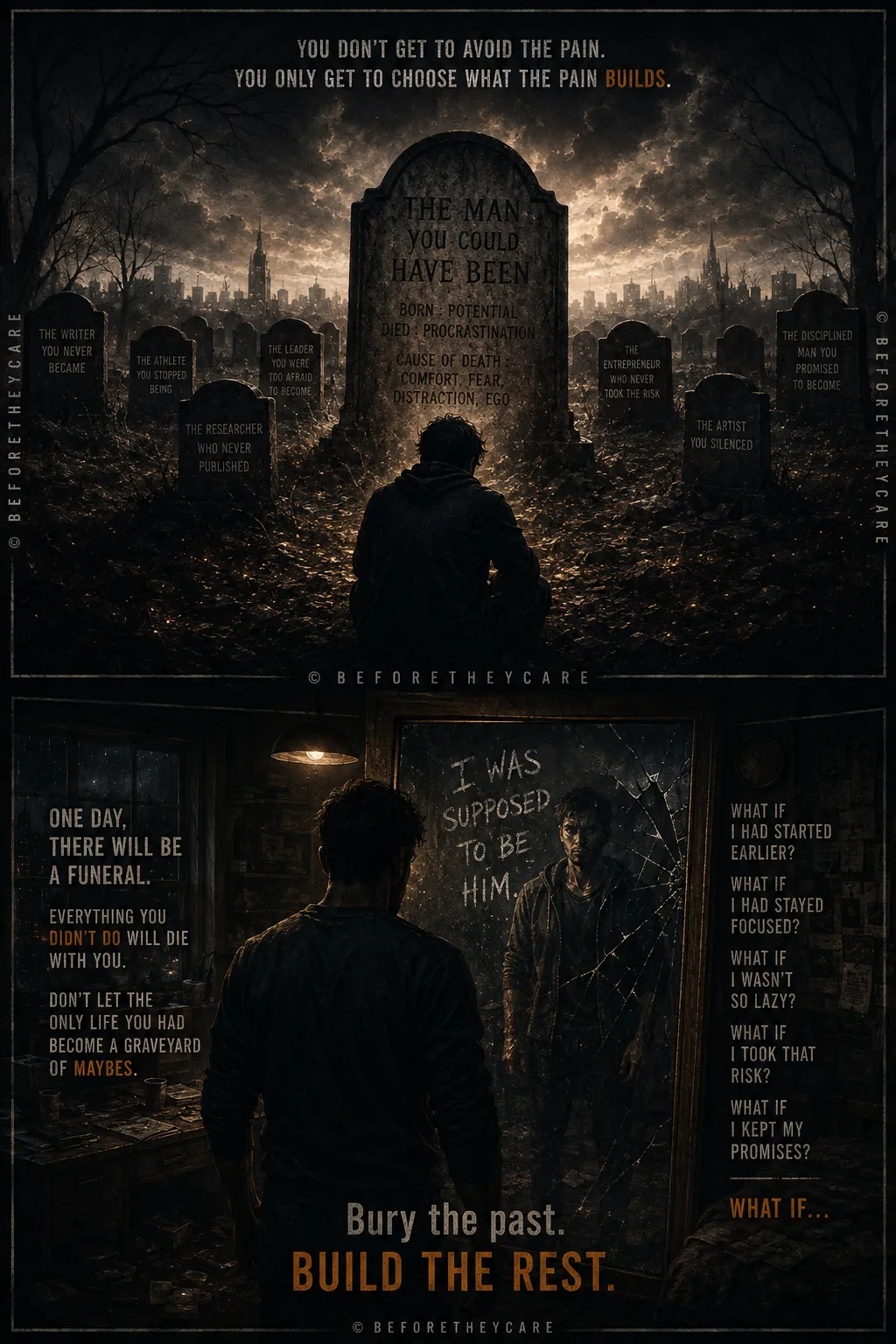
Your mind does not trust you anymore.
Why should it?
It has heard your speeches.
Seen the plans.
Felt the intensity.
Then watched you disappear.
Do not demand belief.
Earn it.
One completed day.
Not a perfect day.
A completed one.
Then another.
A day when the work felt meaningless and you did it anyway.
A week in which you did not redesign your entire life.
A month in which you did not choose a new identity.
A wall encountered without immediately searching for another road.
A failure investigated instead of interpreted as prophecy.
A promise made smaller rather than abandoned.
The old voice will say:
You always leave.
Do not argue.
It has evidence.
Bring more.
Every return is testimony.
Every finished task weakens the case.
Every ordinary day lived according to your word places another brick beneath your feet.
At first, the structure will look pathetic beside the ruins.
Continue.
The past feels heavier because it contains more days.
Give the future days of its own.
You cannot affirm your way back into self-respect.
Self-respect is not a sentence repeated into a mirror.
It is the memory of watching yourself do what you said you would do when no one would have known if you had not.
You May Never Become Extraordinary
Read that slowly.
You may begin now.
Work seriously.
Stay.
Sacrifice.
Learn.
And still never become the person whose name enters history.
You may become good.
Very good.
Perhaps excellent.
Perhaps quietly useful.
Maybe the work reaches a few people.
Maybe nobody understands how difficult it was.
Maybe the world does not care.
Can you continue without a guarantee that the suffering will make you famous?
You must answer that before you begin.
Otherwise, you are not pursuing mastery.
You are negotiating with shame.
You are saying:
I will forgive myself only if I become spectacular enough.
There is no achievement large enough to make the past unhappen.
You cannot succeed so violently that the wasted years become unwasted.
They are gone.
Let them be gone.
Do not make the future repay a debt it never incurred.
Build because building is better than decaying.
Learn because depth is better than self-deception.
Stay because leaving has already taken enough.
Become formidable if you can.
Become useful regardless.
Become someone whose word has weight even if his name does not.
Do Not Make the Living Compete With the Dead
There are people beside you now.
People who do not love the imaginary man.
They never met him.
They love the real one.
The flawed one.
The late one.
The one sitting at the table while his mind wanders toward another life.
Be careful.
Regret can make you absent without moving your body.
You can spend an entire childhood grieving your lost youth.
You can ignore the person asking for your attention because you are trying to rescue a person who does not exist.
You can destroy the living in service of the dead.
Ambition can become another escape route.
You can work so violently to redeem yourself that the people who already believed in you begin learning how little room they occupy inside your redemption.
Do not do that.
There are men who provide everything except presence.
Men who build a legacy their children experience as abandonment.
Men who become impressive to strangers and inaccessible at home.
That is not victory.
That is failure wearing a suit.
The funeral should make you more alive.
More present.
More aware that ordinary afternoons are disappearing too.
Do not miss the life you have while prosecuting yourself for the one you missed.
Your Children Should Not Grow Up Beneath a Ghost
A child does not need to hear constantly about the person you could have been.
He should not feel that his real father is a disappointment standing in the shadow of an imaginary one.
He does not need your unfinished dreams placed on his shoulders.
He does not exist to avenge your wasted potential.
Do not make him achieve what you failed to achieve so the family story can feel corrected.
Do not punish his uncertainty because you regret your own.
Do not turn guidance into panic.
Give him what you lacked if you can.
Exposure.
Time.
Encouragement.
Standards.
But also give him permission to become someone you did not imagine.
Your regret is information.
It is not his destiny.
The greatest thing he may learn from you is not how to avoid every mistake.
It is how to live after making irreversible ones.
How to admit:
I lost time.
Without deciding that all remaining time is worthless.
How to say:
I failed myself.
Without transforming failure into identity.
How to bury a ghost without climbing into the grave.
One Day, There Will Be a Real Funeral
This is the part you keep avoiding.
One day there will be a coffin.
Or ashes.
Or whatever form remains after the body stops negotiating.
There will be people standing around with fragments of you.
Stories.
Messages.
Photographs.
Things you built.
Things you repaired.
Ways you hurt them.
Ways you stayed.
At that funeral, nobody will speak about your potential.
Potential belongs only to the living.
After death, life separates brutally into two categories:
What you did.
What died with you.
The unwritten work dies.
The apology dies.
The language you planned to learn dies.
The questions you never pursued die.
The tenderness you felt but never expressed dies.
Every “someday” is pronounced dead at once.
That funeral is coming.
Probably not today.
That is what makes today dangerous.
There is breakfast.
Traffic.
Messages.
Bills.
A child calling from another room.
Ordinary life disguises the countdown.
The days do not feel like they are disappearing.
They feel like they are being replaced.
Until one is not.
Have the smaller funeral now.
Bury the imaginary man before the real funeral buries every man still available to you.
Walk Away From the Grave
There is no final speech.
No clean absolution.
No guarantee that you will not relapse into mourning tomorrow.
You probably will.
A familiar name will appear.
Someone will achieve something that opens the wound.
You will feel the old life moving beneath the earth.
Let it move.
Do not dig.
The dead man has nothing new to teach you.
You already know why he died.
Delay.
Fear.
Inconsistency.
Unchosen years.
A love of beginnings.
A terror of remaining ordinary long enough to become good.
You have the autopsy.
Stop reopening the body.
Go home.
There is work waiting.
Small work.
Real work.
Work that will not immediately redeem anything.
Do it anyway.
There are people waiting.
See them.
There is a body still capable of movement.
Use it.
There is a mind still capable of depth.
Train it.
There is a promise you can keep before midnight.
Keep it.
The man you could have been is dead.
Let him die.
Mourn him honestly.
Bury him completely.
Then stop introducing yourself through his absence.
You are not the ruins of his life.
You are the beginning of whatever can still be built from yours.
And perhaps, years from now, when you look into the mirror, you will not see the prodigy who vanished or the legend who never arrived.
You will see something less glamorous.
Something rarer.
A man who understood too late—
and stayed anyway.