Stop Leaving : Before Your Son Learns How
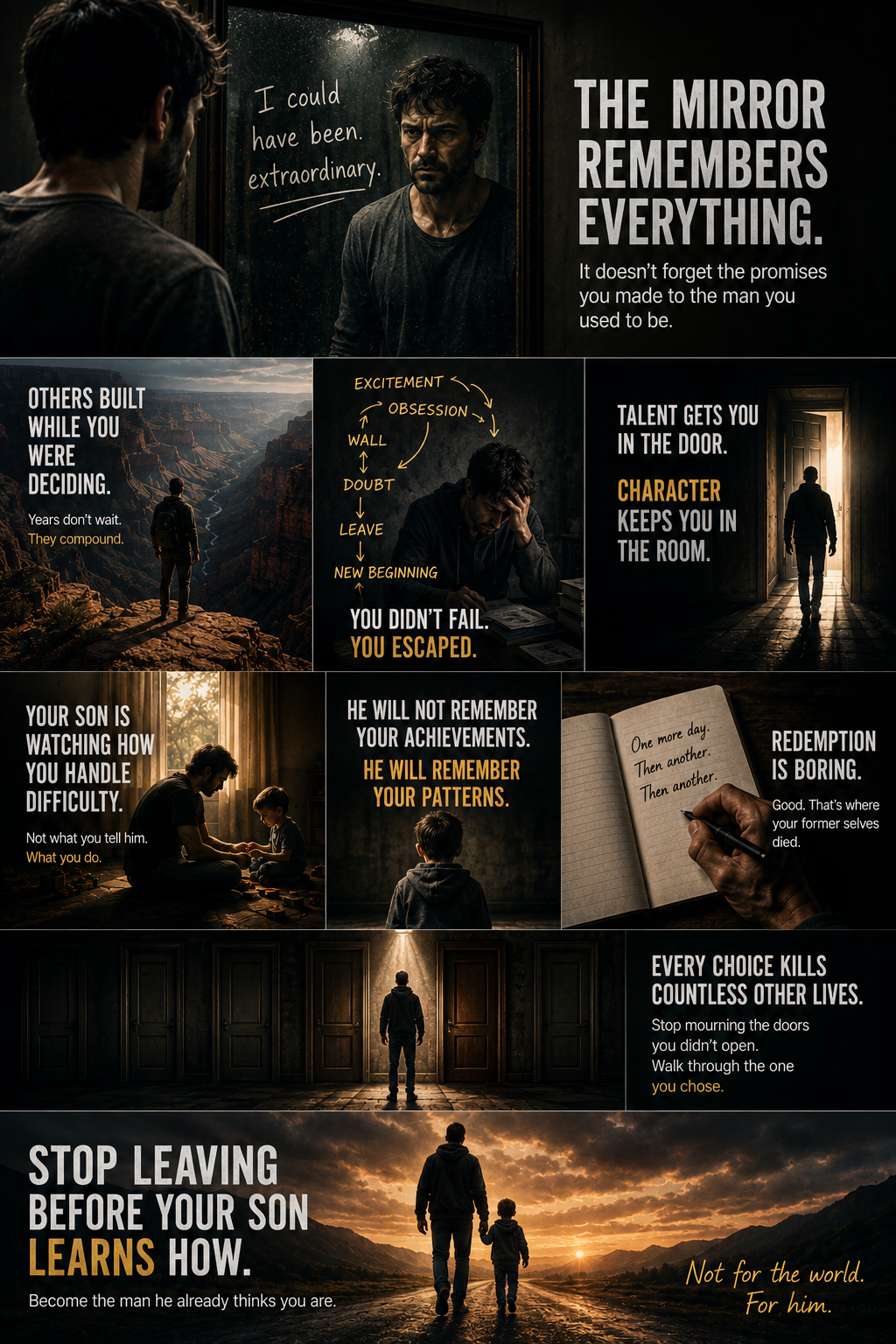 |
 |
You cannot save the boy who wasted his time. But another boy is learning what a man does with regret.
One day, your son will stop believing you are invincible.
Not because he sees you fail.
Children can survive seeing their fathers fail.
He will stop believing when he notices the pattern.
The promises that arrive loudly.
The effort that burns violently.
The first obstacle.
The silence afterward.
The new dream.
The new plan.
The new version of you that lasts until life demands something more difficult than enthusiasm.
He will not understand it at first.
He will only notice that his father is always beginning.
Always preparing.
Always about to become something.
Always explaining why the last attempt did not work.
Children do not inherit our advice.
They inherit our patterns.
And one day, when he reaches his own wall, he will not remember what you told him about perseverance.
He will remember what you did when the work stopped praising you.
So before he learns how to leave—
Stop leaving.
The Mirror Is an Archive
The mirror does not accuse you.
It does something worse.
It remembers.
It remembers the first time you realized you were different.
The things you understood quickly.
The patterns you saw before they were explained.
The moments when difficult ideas felt strangely natural.
The adults who looked at you and saw promise.
The private certainty that your life would eventually become something undeniable.
You did not know exactly what.
But you knew it would be more than this.
More than routine.
More than comfort.
More than watching the years move while something inside you remained unused.
You carried that belief for so long that it became part of your identity.
You were not successful yet.
But you had potential.
You were not disciplined yet.
But you were capable of extraordinary discipline once the right mission appeared.
You had not built anything.
But you knew you could.
You had not proved yourself.
But you were certain the proof would come later.
Later became your religion.
The future was where everything would be repaired.
The future would reveal the intelligence nobody had fully seen.
The future would justify the wasted years.
The future would prove that your inconsistency had only been temporary.
Then the future arrived.
It looked like another ordinary morning.
Then another.
Then another.
The mirror watched the distance grow between the man you imagined and the man your habits were constructing.
It watched possibility become delay.
Delay become pattern.
Pattern become identity.
Now you stand before it carrying a private humiliation nobody else can see.
Your life may not look ruined.
That is what makes it dangerous.
A ruined man knows he is in danger.
A comfortable man can abandon himself for decades without anyone noticing.
He can earn well.
Laugh.
Travel.
Raise a family.
Sleep in a warm house.
And still feel something rotting beneath the surface.
Comfort can preserve a corpse.
The corpse of the man he kept saying he would become.
Potential Eventually Changes Its Name
Potential sounds beautiful when you are young.
It sounds like possibility.
Promise.
Destiny waiting for the correct moment.
Later, potential begins to sound different.
It becomes the word people use when there is no body of work to point toward.
No finished proof.
No built thing.
No difficult road survived long enough to transform the traveller.
Potential becomes a polite description of unused ability.
Then, eventually, it becomes an accusation.
Because ability does not remain untouched while you postpone using it.
Time enters everything.
The mind you do not train becomes impatient.
The discipline you do not practise becomes foreign.
The difficult work you avoid becomes more frightening.
Meanwhile, other people continue.
They may not understand as quickly as you.
They may not possess your instinct.
They may never produce the flashes that once made you feel exceptional.
But they return.
While you are choosing, they are practising.
While you are restarting, they are accumulating.
While you are protecting the idea of your greatness, they are becoming good.
Then very good.
Then frighteningly capable.
The gap begins quietly.
At first, you can still tell yourself you could catch them.
Then the gap compounds.
Knowledge compounds.
Endurance compounds.
Reputation compounds.
Relationships compound.
Judgment compounds.
Confidence earned through completed work compounds.
So does avoidance.
One day, you look across the distance and it no longer resembles a gap.
It resembles a canyon.
You remember when the people on the other side stood beside you.
Perhaps you were even ahead.
Now their years have become structure.
Your years have become explanations.
No explanation is wide enough to become a bridge.
Talent Was Your Alibi
You thought talent was the reason you would succeed.
For years, it became the reason you did not have to begin seriously.
You could always tell yourself:
I have not failed. I simply have not given everything yet.
That sentence protected you.
It meant every defeat was inconclusive.
Every abandoned path remained evidence of what might have happened.
You had never truly tested your limits.
Therefore, your limits could remain imaginary.
Infinite.
Untouched.
You could preserve the belief that, under different conditions, with better timing, stronger guidance, fewer distractions or one final surge of focus, you would have become extraordinary.
Perhaps some of that is true.
Perhaps you did lack guidance.
Perhaps the world around you was smaller than the world you were capable of entering.
Perhaps opportunities existed that nobody taught you to see.
Perhaps the people responsible for guiding you did the best they could with the map they possessed.
Perhaps you really were capable of more.
None of that returns the years.
And none of it explains why, after you finally understood what had been lost, you continued repeating the same pattern.
At some point, ignorance stopped being the reason.
At some point, you knew.
You knew that time mattered.
You knew that mastery required years.
You knew that every restart destroyed compounding.
You knew that the wall was coming.
You still left.
Talent became the perfect alibi because it allowed you to worship what you might do while avoiding judgment on what you had done.
You were not living from potential.
You were hiding inside it.
You Did Not Change Direction
You changed hiding places.
A new subject appeared.
A new craft.
A new mission.
For a while, it consumed you.
You learned fast.
The early stages fed the identity you needed.
You felt awake again.
Capable again.
Dangerous again.
You imagined where this path might lead.
The books you would master.
The work you would produce.
The recognition that would finally silence the private trial inside your head.
This was it.
The thing you had been waiting for.
Then the easy progress ended.
The field stopped revealing itself quickly.
The work became repetitive.
The concepts became dense.
The people ahead of you seemed impossibly far away.
Your first serious attempt failed.
The second failed without teaching you enough.
The novelty disappeared and left you alone with the price of competence.
Years.
Not weeks.
Years of being worse than you wanted to be.
Years of producing work that did not match your taste.
Years of meeting people younger than you who had already travelled farther.
Years of waking without inspiration and returning anyway.
You began to question the path.
Perhaps this was not your real calling.
Perhaps another field suited your abilities more naturally.
Perhaps your strengths lay elsewhere.
Perhaps the lack of progress was a sign.
So you found something new.
You called it curiosity.
It was often escape.
You called it flexibility.
It was often fear.
You called it keeping your options open.
It was often an inability to endure the death of excitement.
Every new obsession gave the previous abandonment a new identity.
You did not move forward.
You changed hiding places.
The Wall Was Not Telling You to Stop
The wall was asking who you were without applause.
Everything before the wall was introduction.
Curiosity carried you.
Natural ability carried you.
Excitement carried you.
The fantasy of eventual greatness carried you.
Then the wall removed all of it.
The wall did not care how quickly you had understood easier things.
It did not care how much potential you possessed.
It did not care what people once said about you.
It asked a simpler question:
Will you remain when this no longer makes you feel gifted?
You treated confusion like evidence that you had chosen incorrectly.
It was evidence that the real work had begun.
You treated slow progress like a verdict.
It was the entrance fee.
You treated the presence of better people like proof that you were too late.
They were showing you what accumulation looked like.
You wanted a path that continued confirming your identity.
No serious path will do that.
Every meaningful discipline eventually humiliates the person entering it.
Mathematics will take away your certainty.
Research will take away your answer sheet.
Programming will place your confidence before an indifferent judge.
Writing will expose the difference between what you feel and what you can express.
Business will punish your plans with reality.
Art will show you how far your taste exceeds your ability.
The body will stop responding to motivation and demand routine.
Every real pursuit eventually stops asking how talented you are.
It asks how much of your ego you are willing to bury to continue.
That is where you kept leaving.
Not at the end.
At the beginning.
You Are Addicted to Beginnings
Beginnings make you feel innocent.
Nothing has failed yet.
The notebook is clean.
The schedule is perfect.
The tools are prepared.
The future remains untouched by fatigue, interruption, illness, doubt or boredom.
In the beginning, you are still the person who will do everything correctly.
You have not missed a day.
You have not broken the promise.
You have not discovered the limits of the plan.
You feel powerful because reality has not yet arrived.
That is why beginnings seduce you.
A beginning gives you the emotional experience of transformation without forcing you to transform.
You reorganize the room.
Purchase the books.
Design the system.
Research the methods.
Write the timetable.
Imagine the result.
You feel the high of becoming without paying the cost of repetition.
Then the work becomes ordinary.
The clean notebook fills with mistakes.
The schedule meets a bad week.
The initial energy collapses.
Your mind stops producing the chemicals that made the mission feel inevitable.
Now the plan asks for loyalty.
You have always confused loyalty with motivation.
Motivation says:
I want this today.
Loyalty says:
I chose this, and today does not get to renegotiate the choice.
You have had enough beginnings.
You do not need another resurrection performed over a weekend.
You need a middle.
A long, silent, repetitive middle.
A middle where nobody is impressed.
Where progress becomes difficult to measure.
Where you are not sure whether the work is changing anything.
Where you return anyway.
You do not need another perfect first day.
You need a thousand imperfect second days.
Time Did Not Betray You
Time did exactly what time does.
It moved.
You thought it would announce its departures.
It did not.
There was no final warning before the last easy opportunity closed.
No bell before one season of life became another.
No visible border between “I still have time” and “I should have begun years ago.”
Time did not steal your life in one dramatic robbery.
You handed it away in ordinary transactions.
An evening.
A week.
A postponed decision.
A month spent preparing to begin.
A year spent fascinated by something you did not continue.
A decade built from days that felt too small to matter.
They mattered.
That is the cruelty of time.
It hides enormous consequences inside harmless moments.
One wasted day does not destroy a life.
That is why it is so easy to waste.
But one wasted day repeated becomes a person.
Now you understand.
You know what years can do.
You have seen how quietly they turn small differences into permanent distances.
Do not use that understanding only to torture yourself.
Use it to become dangerous.
You may not have the innocence of youth anymore.
Good.
Innocence allowed you to waste time because you did not understand its violence.
Now you understand.
Let that knowledge become discipline instead of poison.
Your Son Does Not Know You Failed
Not yet.
He does not know the private standard against which you measure yourself.
He does not know what you believed you would become.
He does not know how many paths you abandoned.
He does not know the names of the opportunities that still wake you at night.
He does not know which achievements you see in other men and quietly translate into accusations against yourself.
He knows your face.
Your voice.
Your footsteps.
He knows how it feels when you lift him.
He knows whether you kneel when he speaks.
He knows the safety of your hand.
The shape of your presence.
The way his mother looks when you enter the room.
To him, you are not a failed version of another man.
You are his father.
That may be the purest admiration you will ever receive.
It is also the admiration you are most capable of destroying.
Not by failing.
Failure will not destroy it.
Children can watch a father lose and still love him completely.
What damages them is watching a father repeatedly abandon himself.
Watching his words lose weight.
Watching promises arrive with energy and disappear without explanation.
Watching frustration become anger.
Watching regret become bitterness.
Watching a man blame the world for the life his habits are still creating.
Your son will eventually notice.
He will not need to understand your work.
He will understand your relationship with difficulty.
He will learn whether walls are places where men become stronger—
or places where they become someone else.
He Will Inherit Your Pattern
One day, he will reach his own wall.
The subject will stop coming naturally.
The team will reject him.
The performance will expose him.
Someone less gifted will move ahead because they prepared longer.
The thing he thought made him special will stop being enough.
He will feel the humiliation you know so well.
And in that moment, he will search for instructions.
He may not remember your advice.
He will remember your shape in front of difficulty.
Did you remain?
Did you keep your word after the emotion disappeared?
Did you admit when you were wrong?
Did you return to the work after being embarrassed?
Did you become curious about failure—or wounded by it?
Did you spend your life telling stories about the man you could have become?
Did every obstacle produce a new identity?
Did every loss become permission to leave?
Your life is teaching him long before you begin teaching him deliberately.
Children are always studying.
They study what we tolerate.
What we avoid.
What we repeat.
What we become when things do not go our way.
You can tell him to finish what he starts.
But your unfinished lives will speak louder.
You can tell him that effort matters.
But he will notice whether your effort survives silence.
You can tell him not to fear failure.
But he will watch what failure does to your face.
The lesson is not what you say.
The lesson is what remains after your words are gone.
Do Not Make Him Carry Your Unlived Life
Your son is not here to redeem you.
He is not the final judge in the courtroom of your self-worth.
He does not owe you the admiration required to silence your regret.
Do not make his pride the life-support system for your dignity.
That burden is too heavy for a child.
Do not chase greatness so desperately that every achievement becomes a demand:
Look at me. Tell me my life mattered.
He needs a father.
Not a man begging his child to certify his worth.
He needs presence more than spectacle.
Patience more than status.
Safety more than a legend.
Do not become absent from his life while trying to become someone he might one day admire.
Do not abandon the home to prove you are worthy of returning to it.
That is not redemption.
That is the same disease in a more respectable form.
Ambition can become another way of leaving.
You can disappear into work as easily as you disappeared from it.
You can make your family pay for your war against yourself.
You can become so obsessed with correcting the past that you miss the life the past was supposed to prepare you for.
Your wife and child are not the audience for your comeback.
They are part of the life you must not burn down to prove that you have one.
Let your son become a reason to live more honestly.
Not a witness you force to applaud.
Become someone he can admire.
Remain someone he can reach.
He Does Not Need You to Be Extraordinary
He needs your word to mean something.
That is rarer than brilliance.
He needs to see you say:
I failed.
Without collapsing.
I was wrong.
Without becoming defensive.
I do not know.
Without feeling smaller.
I will return tomorrow.
And then return.
He needs to see that strength is not the absence of humiliation.
It is the ability to survive humiliation without surrendering your character.
He needs to see that ambition can coexist with kindness.
That discipline does not require cruelty.
That seriousness does not require becoming emotionally unavailable.
That a man can pursue difficult things and still sit on the floor when his child asks him to play.
He may one day be proud of something you build.
But before that, let him be proud of the man building it.
Let him see you work without becoming consumed by rage.
Fail without punishing the household.
Improve without announcing every step.
Rest without disappearing.
Love without treating love as an obstacle.
A superhero is not a man who always wins.
A superhero is a man whose child watches him lose without watching him run away.
Do Not Try to Defeat the Imaginary Man
There is a perfect version of you living inside your head.
He understood time early.
He found the right mentor.
He chose the correct field.
He never became distracted.
He worked consistently.
He compounded for decades.
He stands somewhere in your imagination carrying every achievement you believe should have been yours.
You compare yourself with him.
Of course you lose.
He was designed to defeat you.
He never had to live through reality.
He never became tired.
Never became afraid.
Never faced the responsibilities you face.
Never chose incorrectly.
Never suffered through ambiguity.
Never had to continue after his self-image collapsed.
He is not a person.
He is a weapon built from hindsight.
Stop allowing a fictional man to humiliate a real one.
You cannot outperform a life that contains no mistakes.
You cannot return to the beginning carrying the knowledge of the ending.
You cannot save every version of yourself that might have existed.
Some of them are gone.
Some doors have closed.
Some opportunities will not return.
Some heights may now be impossible.
Say it without flinching.
Grief becomes dangerous when you refuse to name what has died.
Mourn the lives you lost.
Then bury them.
Stop dragging their bodies into every new attempt.
They are not coming back.
But you are still here.
Your Past Is Not the Tragedy
The tragedy would be using your past to destroy what remains.
You lost years.
Do not lose the next decade explaining the previous one.
You missed compounding.
Do not respond by refusing to begin because others are already ahead.
You betrayed your own promises.
Do not use that betrayal as evidence that every future promise must also fail.
Regret should create urgency.
Instead, most people use it to create paralysis.
They stare backward so intensely that the future escapes through the same door.
They call it reflection.
It is often another form of avoidance.
There is a point beyond which analysing the wound becomes a way of refusing to heal it.
You already know what happened.
You left.
You left when things became slow.
You left when you felt ordinary.
You left when another path looked cleaner.
You left when your talent could no longer protect your ego.
You do not need another explanation.
You need a different action.
“Too Late” Is the Final Hiding Place
Perhaps it is too late for some things.
That sentence can be true.
The danger is what comes after it.
The mind takes a partial truth and turns it into total permission.
Some doors are closed.
Therefore, nothing meaningful remains.
Some people are decades ahead.
Therefore, effort is pointless.
You cannot become the person you might have been.
Therefore, you should not become the person still available to you.
That is how regret finishes the work it began.
It convinces you that because you wasted one part of your life, the remaining part no longer deserves protection.
“It is too late” can sound like realism.
Often, it is fear finally finding an argument intelligent enough to end the fight.
If everything is over, you are free from responsibility.
You never have to risk discovering what you can still become.
You can remain untouched by another verdict.
You can carry potential into old age, still untested.
Still infinite.
Still useless.
Do not let the fear that protected your fantasy in youth become the philosophy that buries you later.
You may not reach every height.
Reach one.
You may not become legendary.
Become formidable.
You may not recover the lost years.
Stop donating new ones to their memory.
Do Not Plan a Glorious Return
You are vulnerable to drama.
The legendary comeback.
The impossible schedule.
The transformation so extreme that it erases years of disappointment in a few months.
Be careful.
Grand plans are often the same old addiction wearing armour.
You imagine the final result.
The recognition.
The moment your life changes shape.
The day everyone understands what was always inside you.
The day you finally forgive yourself.
That fantasy creates intensity.
Intensity creates an impossible plan.
The impossible plan survives until ordinary life interrupts it.
A bad night.
A sick child.
A demanding week.
A missed session.
One crack appears.
Because the plan allowed no weakness, the crack becomes collapse.
You leave again.
Do not attempt to repair decades through violence against the present.
You do not need a glorious return.
You need an unremarkable one.
Quiet.
Measured.
Sustainable.
A routine that survives disappointment.
A commitment small enough to continue on the days when you hate yourself.
A direction you do not abandon merely because progress refuses to entertain you.
Redemption will not feel like redemption while it is happening.
It will feel boring.
Good.
Boring is where your former selves went to die.
Learn to live there.
Choose a Mountain and Accept the Funeral
Every serious choice kills other lives.
That is why you keep avoiding it.
Choosing one path means burying the fantasy of becoming exceptional in five others.
It means accepting that curiosity cannot become commitment everywhere.
It means closing doors voluntarily before time closes all of them for you.
You have spent years examining mountains.
Comparing their summits.
Reading the stories of people who climbed them.
Imagining which view would finally make your life feel complete.
Choose one.
Not because certainty has arrived.
It will not.
Not because it is guaranteed to be the perfect expression of your ability.
No path can guarantee that.
Choose something worthy of years.
Something difficult enough to expose you.
Something meaningful enough to survive boredom.
Then accept the funeral.
The other possible selves will scream.
Let them.
You cannot become every person you might have become.
Your refusal to choose has not preserved those lives.
It has killed them slowly while preventing one real life from forming.
The road not taken will always look cleaner.
It has no mud because you never walked on it.
Stop worshipping clean roads.
Build Evidence Against the Man You Were
You do not trust yourself anymore.
You should not.
Trust is not owed to someone who repeatedly breaks his word.
Do not ask yourself for blind faith.
Bring evidence.
One day completed.
Then another.
A bad day in which you still kept the minimum promise.
A week without redesigning the system.
A month without announcing a new identity.
A wall encountered.
A wall survived.
A failure studied instead of escaped.
A temptation to restart resisted.
A morning when you returned without motivation.
The voice inside you will say:
You always leave.
Do not argue.
It has years of evidence.
Build more.
Every kept promise is a statement under oath.
Every return weakens the prosecution.
Every completed cycle becomes a witness for the defence.
At first, it will feel pathetic.
A few disciplined days cannot outweigh years of abandonment.
Continue.
The past feels heavier because it contains more proof.
Give the future proof of its own.
You cannot think your way back into self-respect.
You must behave your way there.
Self-respect is not a feeling you manufacture.
It is the memory of promises kept when breaking them would have been easier.
One day, the mirror will still remember everything.
But it will no longer show only the man who left.
It will show the man who returned.
You May Never Be Known
The world may never care.
Your work may never become famous.
You may become excellent in silence.
You may create something valuable that travels no farther than a small room.
You may spend years building depth that no crowd knows how to measure.
You may never receive the grand recognition your younger self imagined.
Would the work still matter?
Would becoming disciplined still matter?
Would producing something true still matter?
Would becoming a man whose word carries weight still matter?
If the answer is no, then you do not want mastery.
You want witnesses.
Be honest about that.
There is nothing evil about wanting recognition.
But it is unstable ground on which to rebuild a life.
The crowd arrives late.
The crowd misunderstands.
The crowd rewards things for reasons unrelated to their value.
The crowd may never come.
Your son may never fully understand the technical difficulty of what you build.
He will understand what the building does to you.
He will see whether the work makes you steadier.
More patient.
More alive.
More capable of keeping your word.
He will see whether his father still speaks mostly about what he might have been—
or whether he finally became occupied with what he is doing.
The Boy You Were Is Gone
You cannot save him.
You cannot return to his room and take the distraction from his hands.
You cannot place the correct book before him.
You cannot introduce him to the mentor he never met.
You cannot force him to understand that the years he is wasting are not small.
You cannot make him feel the future regret that would have frightened him into action.
He believed time would wait.
It did not.
He failed to protect your future.
Do not spend the rest of your life punishing him.
And do not make another child pay for what the first child did not understand.
There is another boy in the story now.
One who does not need to inherit your regret.
One who does not need a perfect father.
One who needs to watch a man confront his own history without becoming its prisoner.
You cannot change what the first boy wasted.
You can change what the second boy learns.
Become the Man He Already Sees
When your son looks at you, he does not see the corpse of your potential.
He sees his father.
Do not wait until his admiration becomes informed before deciding to deserve it.
Become the man he assumes you are.
Not invincible.
Reliable.
Not famous.
Present.
Not incapable of failure.
Capable of returning.
Become a man who no longer requires a new identity whenever reality wounds the old one.
Become a man whose ambition does not need witnesses.
A man who can spend years on something without demanding that every month prove the years will be worth it.
A man who finishes.
A man who knows that success is uncertain but character is being constructed every day.
He may one day be proud of what you achieve.
First, let him be proud of how you live.
Let him see that losing is survivable.
That confusion is not shameful.
That difficult things deserve patience.
That promises are not emotions.
That a man can be disappointed in himself without becoming cruel to everyone who loves him.
That he can pursue greatness without making his family feel like an obstacle.
That he can work in silence and return home with tenderness.
You do not need to conquer the world for your son.
You need to stop abandoning yourself in front of him.
The Next Wall Is Coming
This post will not change that.
Inspiration will not remove it.
Understanding your pattern will not kill the pattern.
The next wall will still come.
The work will slow.
Your confidence will drop.
Someone else will advance faster.
The subject will stop making you feel intelligent.
Another opportunity will appear cleaner.
Another identity will invite you to begin again.
The old voice will return:
Maybe your real potential lies somewhere else.
Recognize it.
That voice has buried enough versions of you.
Do not debate it.
Do not wait until it becomes quiet.
Return to the work while it is still speaking.
Return the next morning.
Then the morning after that.
Not with rage.
Not with a speech.
Not with another impossible promise.
With the quiet refusal to repeat your oldest betrayal.
You do not have to prove that you will remain for ten years.
Remain today.
Then collect another day.
Let the days become evidence.
Let the evidence become character.
Let character become the life you once expected talent to produce automatically.
You have spent enough time being the man who could have been.
Become the man who was there.
There when the excitement disappeared.
There when talent stopped being enough.
There when the work became repetitive.
There when the wall refused to move.
There when nobody applauded.
There when your own mind called surrender wisdom.
There when your son looked up.
One day, he will reach a wall of his own.
He will not remember every word you gave him.
He will remember what your life taught him to do.
Do not teach him how to leave.
Stop leaving before your son learns how.